Back on the audio bench: a Moog Modular returns for annual checkup
NEriks Audio AB owns and maintains a small collection of rare electronic musical instruments. As we do not use the instruments ourselves, they are all placed on long-term loan with musicians and music studios, where they remain in practical use rather than being kept purely as collection pieces.
One of these instruments is an original Moog Modular System 35 from 1974, with a Sequencer Complement cabinet.
Like other complex analogue electronic systems of its age, the Moog requires regular attention to remain reliable and correctly calibrated. Routine adjustments and minor maintenance are carried out when needed, while a more thorough inspection is performed approximately once a year.
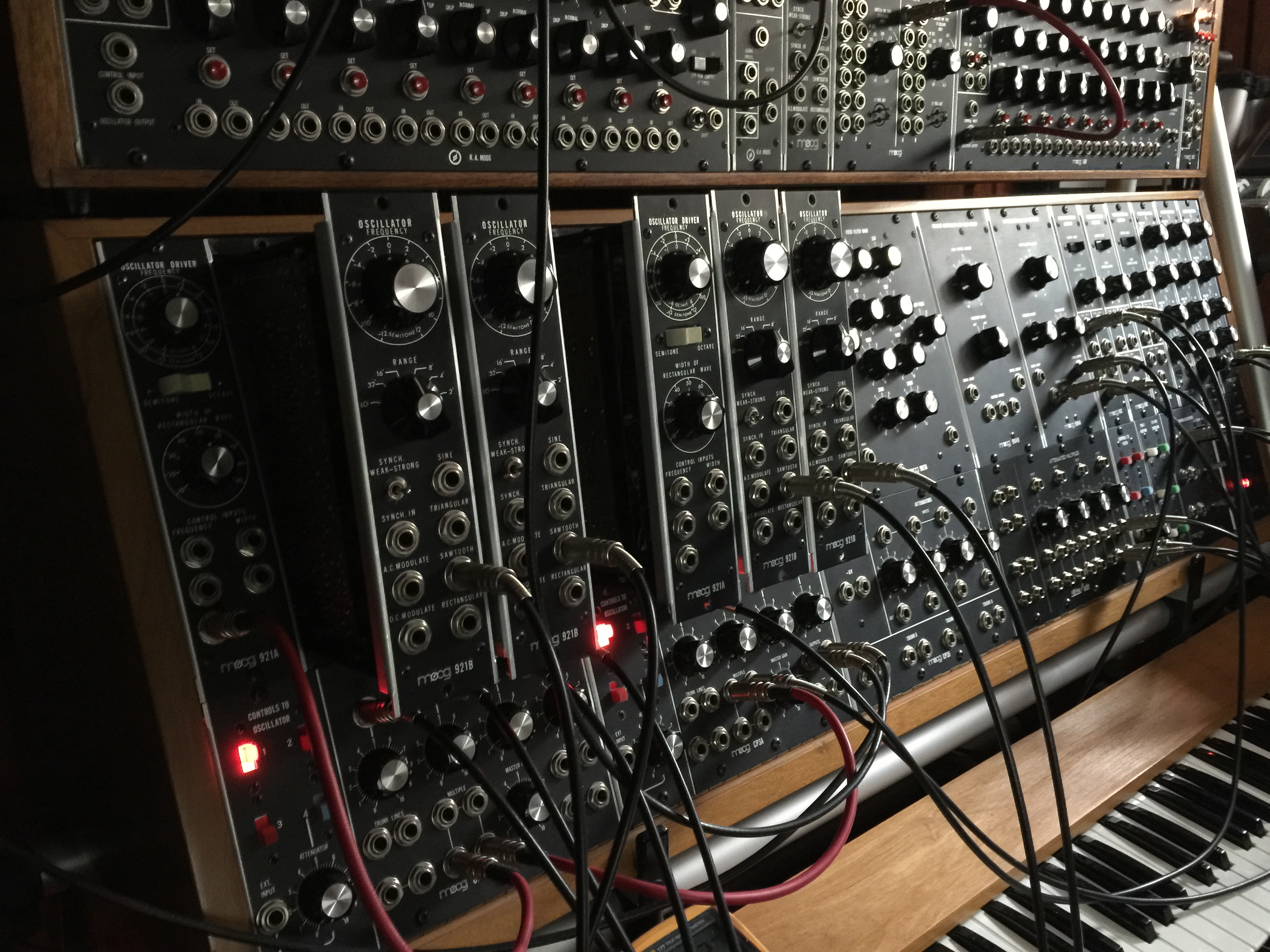 FIG.01
The annual maintenance is in some ways comparable to the philosophy behind an annual aircraft inspection: rather than waiting for an obvious fault to develop, the system is examined systematically and its condition and operation are checked.
For the Moog, this involves working through the instrument module by module and checking the functions that are important to its operation.
Depending on findings, the work can include functional testing, inspection of connections and power distribution, cleaning of controls and contacts, adjustment and calibration of oscillators and other modules, and investigation of any irregularities identified during use or testing.
The purpose is not to modify or modernise the instrument unnecessarily, but to keep it functioning as intended while preserving as much of the original equipment as practical.
The annual maintenance is in some ways comparable to the philosophy behind an annual aircraft inspection: rather than waiting for an obvious fault to develop, the system is examined systematically and its condition and operation are checked.
For the Moog, this involves working through the instrument module by module and checking the functions that are important to its operation.
Depending on findings, the work can include functional testing, inspection of connections and power distribution, cleaning of controls and contacts, adjustment and calibration of oscillators and other modules, and investigation of any irregularities identified during use or testing.
Analogue synthesizers rely on numerous electronic circuits whose characteristics can gradually change with age, component drift and environmental conditions.
Oscillator tuning and tracking are particularly noticeable, but calibration can also affect filters, envelope generators, control voltages and other functions throughout a modular system.
Regular checks make it possible to identify gradual changes before they develop into more significant problems and help keep the instrument predictable and useful in a studio environment.
Our approach to historic electronic instruments is that they should, where practical, remain functional and usable.
The Moog System 35 is therefore maintained as a working musical instrument rather than simply preserved as a static historical object. Keeping it in regular professional use also provides useful feedback about faults, drift and other issues that may not become apparent when an instrument is only occasionally powered up.
This combination of preservation, preventive maintenance and practical use is an important part of how NEriks Audio looks after the instruments in its collection.
Work with analogue synthesizers and professional audio electronics goes back to the origins of NEriks Audio and remains part of the company's activities today.
Maintaining equipment such as this Moog requires the same fundamental skills that have always formed the basis of our electronics work: understanding circuits, systematic fault diagnosis, measurement, calibration and careful hands-on work with equipment that may no longer have readily available replacement parts.
- Instrument
- Moog modular
- Work
- Annual maintenance
- Discipline
- Analogue electronics